Q1.Study the entries in the following table and rewrite them, putting the connected items in a single row.
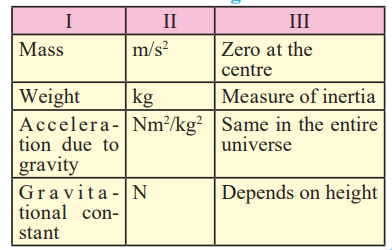
| Concept | Unit / Description | Special Property |
| Mass | kg | Measure of inertia |
| Weight | N | Depends on height |
| Acceleration due to gravity | m/s² | Zero at the centre |
| Gravitational constant | Nm²/kg² | Same in the entire universe |
2. Answer the following questions
a. Difference between mass and weight. Will they be the same on Earth and Mars?
- Mass = amount of matter in an object. It is constant everywhere. Unit: kg.
- Weight = force with which Earth (or any planet) pulls the object.
Formula:(g = gravity of that planet). Weight changes with planet.
- On Mars:
- Mass remains same (e.g., 5 kg on Earth = 5 kg on Mars).
- Weight changes because Mars has smaller
.
b. Definitions
(i) Free fall – When an object falls only under the influence of gravity (no air resistance, no other force).
(ii) Acceleration due to gravity () – The acceleration experienced by a freely falling object due to Earth’s pull. On Earth,
.
(iii) Escape velocity – The minimum velocity required to escape a planet’s gravitational pull without further propulsion.
For Earth: .
(iv) Centripetal force – The force that keeps an object moving in a circular path. It acts towards the center.
c. Kepler’s three laws and how they helped Newton
Kepler’s laws (for planets around the Sun):
- Law of orbits – Planets move in elliptical orbits with the Sun at one focus.
- Law of areas – A line joining a planet to the Sun sweeps equal areas in equal times (planet moves faster when closer).
- Law of periods –
(square of time period ∝ cube of average distance from Sun).
How they helped Newton:
Newton used Kepler’s 3rd law () and the centripetal force formula
with
to derive that the force of gravity follows the inverse square law:

d. Stone thrown upward: time up = time down
Let initial velocity = , height =
.
- Going up: final velocity
, acceleration
, time
.
Using⇒
⇒
.
- Coming down: initial velocity
, acceleration
, height
.
Usingand also
(from upward motion). Solving gives
.
Thus .
e. If becomes twice, why difficult to pull?
Friction while pulling = , and
weight =
.
If doubles, weight doubles, so normal force doubles, so friction doubles. Hence, twice as difficult.
3. Why is at Earth’s center?
Gravity at a distance The radius from the center (inside Earth) depends only on mass inside radius
.
At the center , enclosed mass = 0. So gravitational force = 0. Hence
.
4. Period of planet: if distance becomes
From Kepler’s 3rd law: .
So:
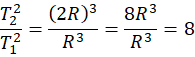

Thus . Proved.
5. Solve the following examples
a. a. An object takes 5 s to reach the ground from a height of 5 m on a planet. What is the value of g on the planet?
Formula:
Answer:
b. The radius of planet A is half the radius of planet B. If the mass of A is MA, what must be the mass of B so that the value of g on B is half that of its value on A?
Given:
Formula:
So:
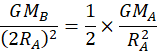
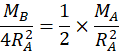
Cancel :
Multiply by 4:
Answer:
- Planet B has twice the radius of planet A.
- But we want gravity on B to be half of gravity on A.
- To make that happen, planet B must have twice the mass of planet A.
c. The mass and weight of an object on earth are 5 kg and 49 N respectively. What will be their values on the moon? Assume that the acceleration due to gravity on the moon is 1/6th of that on the earth.
Ans: 5 kg and 8.17 N
Mass on Moon = same as Earth = (mass never changes).
Weight on Earth = ⇒
(consistent).
Weight on Moon =
= ≈
Answer: and
d. d. An object thrown vertically upwards reaches a height of 500 m. What was its initial velocity? How long will the object take to come back to the earth? Assume g = 10 m/s2 Ans: 100 m/s and 20 s
At top, ,
,
.
Use ⇒
⇒
⇒
Time to come back?
Time up: ⇒
⇒
Total time =
Answer: and
e. A ball falls off a table and reaches the ground in 1 s. Assuming g = 10 m/s2 , calculate its speed on reaching the ground and the height of the table. Ans. 10 m/s and 5 m
Height of table:
Answer: and
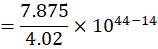
f. f. The masses of the earth and moon are 6 x 1024 kg and 7.4×10²² kg, respectively. The distance between them is 3.84 x 10⁵ km. Calculate the gravitational force of attraction between the two? Use G = 6.7 x 10⁻¹¹ N m2 kg-2
Given:
Formula:
=
Multiply by :
= ≈
Divide by ≈
≈
Answer: (approx.)
g. The mass of the earth is 6 x 1024 kg. The distance between the earth and the Sun is 1.5x 10¹¹ m. If the gravitational force between the two is 3.5 x 10²² N, what is the mass of the Sun? Use G = 6.7 x 10⁻¹¹ N m2 kg-2 Ans: 1.96 x 1030 kg
- Mass of Earth =
- Distance between Earth and Sun =
- Gravitational force =
- Find mass of Sun =
Recall Newton’s law of gravitation
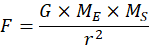
Rearrange to solve for
Multiply both sides by :

Now divide both sides by :

Substitute the values
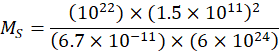
Calculate

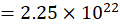
So numerator becomes:


Calculate denominator



Divide numerator by denominator
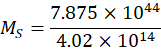

Round off

Answer: