1. Find out my partner.
Answer:
- Heart beats ➡ d. 72 (The average human resting heart rate is about 72 beats per minute.)
- RBC ➡ e. 50 – 60 lakh/mm³ (A normal Red Blood Cell count is roughly 5 to 6 million per cubic millimeter.)
- WBC ➡ f. 5000-6000 per mm³ (A normal White Blood Cell count is in this range.)
- Blood donation ➡ a. 350 ml (A standard single unit of blood donated is about 350 milliliters.)
- Normal body Temperature ➡ c. 37 °C (The normal human body temperature.)
- pH of oxygenated blood ➡ b. 7.4 (Blood is slightly alkaline, with a pH of around 7.4.)
2. Complete the following table.
Answer:
| Organ systems | Organs | Functions |
| 1. Respiratory system | Nose, Trachea (Windpipe), Lungs, Bronchi, Alveoli, Diaphragm | To breathe. It takes in oxygen from the air and removes waste carbon dioxide from the blood. |
| 2. Circulatory system | Heart, Blood Vessels (Arteries, Veins, Capillaries), Blood | To transport materials. It carries oxygen, nutrients, and hormones to cells, and takes away waste like carbon dioxide. |
3. Draw neat and labeled diagrams.
a. Respiratory system
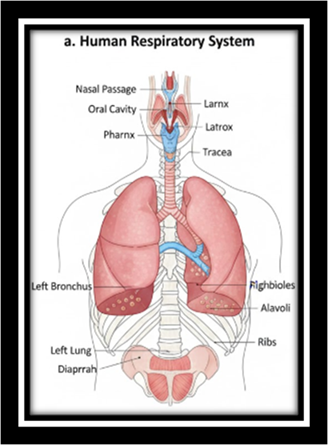
b. Internal structure of heart.
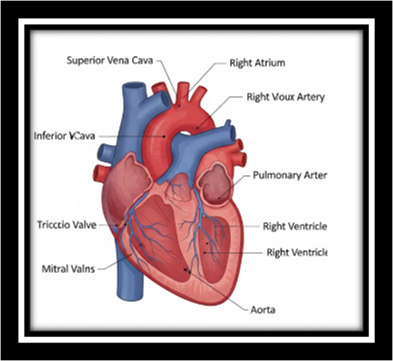
4. Explain with reasons.
a. Human blood is red coloured.
Answer: Human blood is red because of a protein called haemoglobin inside our Red Blood Cells. Haemoglobin contains iron. When this iron binds with oxygen in the lungs, it forms oxyhaemoglobin, which is bright red. This is why oxygen-rich blood from arteries looks red. Blood with less oxygen is darker red, not blue.
b. Upward and downward movement of diaphragm occurs consecutively.
Answer: The diaphragm is a dome-shaped muscle below our lungs. Its movement is what makes us breathe.
- Downward Movement (Inhalation): When the diaphragm contracts and moves down, it creates more space in the chest. The lungs expand, and air is pulled in.
- Upward Movement (Exhalation): When the diaphragm relaxes and moves up, the chest space decreases. This pushes air out of the lungs.
This cycle happens one after the other, non-stop, to keep us breathing.
c. Blood donation is considered to be superior of all donations.
Answer: Blood donation is called the superior donation because it directly saves a life. Unlike money or things, blood cannot be manufactured; it can only come from a human donor. A single donation can be separated into components to help up to three patients. It is a unique gift of health and life that costs the donor nothing but a little time.
d. Person with ‘O’ blood group is considered as ‘universal donor’.
Answer: People with O negative blood type are called universal donors for Red Blood Cell transfusions in emergencies. This is because their red blood cells have no A or B antigens on the surface. If there is no time to check the patient’s blood type, O negative blood is least likely to cause a dangerous reaction because the patient’s immune system won’t see the donated cells as “foreign.”
e. Food must have limited amount of salts.
Answer: Our bodies need a small amount of salt (sodium), but too much is harmful. Excess salt increases the amount of water in our blood, which raises blood pressure. High blood pressure over time strains the heart and blood vessels, leading to heart disease, stroke, and kidney problems. Therefore, limiting salt intake is crucial for long-term health.
5. Answer the following questions in your own words.
a. Explain the functional correlation of circulatory system with respiratory, digestive and excretory system.
Answer: The circulatory system (heart, blood, vessels) is the body’s transport network that connects and supports other systems.
- With Respiratory System: Blood picks up oxygen from the lungs and delivers it to all cells. It also carries waste carbon dioxide from the cells back to the lungs to be breathed out.
- With Digestive System: Blood
absorbs nutrients (like glucose, amino acids) from the small intestine and carries them to the liver and then to all body cells for energy and growth.
- With Excretory System: Blood carries waste products (like urea, extra salts) from the cells to the kidneys. The kidneys filter the blood and remove these wastes as urine.
b. Explain the structure and function of human blood.
Answer:
Structure: Blood is a fluid connective tissue with two main parts:
- Plasma (55%): The liquid part, mostly water, containing proteins, salts, hormones, and nutrients.
- Blood Cells (45%):
- Red Blood Cells (RBCs): Disc-shaped, contain hemoglobin to carry oxygen.
- White Blood Cells (WBCs): The body’s defense army, fight infections.
- Platelets: Tiny cell fragments that help in blood clotting.
Function: Blood has three key jobs:
- Transport: Carries oxygen, nutrients, hormones, and heat around the body. Removes waste like CO2 and urea.
- Protection: WBCs fight germs. Platelets and clotting factors stop bleeding from cuts.
- Regulation: Helps control body temperature and balance water and salt levels (pH).
c. Explain the importance and need of blood donation.
Answer:
Importance: Donated blood is a vital, life-saving resource. It is essential for:
- Patients undergoing major surgeries or organ transplants.
- People with serious injuries from accidents.
- Patients with diseases like cancer, anemia, or thalassemia who need regular transfusions.
- Mothers during childbirth complications.
Need: Blood has a limited shelf life (about 35 days for RBCs) and cannot be manufactured artificially. There is a constant need for donors to maintain a safe and sufficient supply in blood banks to handle everyday emergencies and planned treatments. Regular donations ensure blood is always available for those who need it most.
6. Explain the differences.
a. Arteries and veins.
| Feature | Arteries | Veins |
| Function | Carry blood away from the heart. | Carry blood towards the heart. |
| Blood Type | Usually carry oxygen-rich blood (except pulmonary artery). | Usually carry oxygen-poor blood (except pulmonary veins). |
| Pressure | Blood is under high pressure. | Blood is under low pressure. |
| Wall | Have thick, muscular, elastic walls. | Have thinner, less muscular walls. |
| Valves | Do not have valves (except at heart exits). | Have valves to prevent backflow of blood. |
b. External and internal respiration.
Answer:
- External Respiration: This is gas exchange in the lungs. Oxygen from the inhaled air moves into the blood in the lung’s alveoli. At the same time, carbon dioxide from the blood moves into the alveoli to be exhaled. It is between the air and the blood.
- Internal Respiration: This is gas exchange at the body cells. Oxygen from the blood moves into the body’s tissues and cells. Carbon dioxide, produced as a waste product by the cells, moves from the cells into the blood. It is between the blood and the body cells.
Q7. Which health parameters of blood donor should be checked?
Before a person can donate blood, doctors must check their health to make sure both the donor (the giver) and the receiver are safe. Here are the simple health parameters checked:
1. Age
- The person must be an adult. Usually, the age should be between 18 and 60 years.
2. Weight
- The donor must have a healthy weight. Generally, a person must weigh at least 45 to 50 kg.
3. Hemoglobin Level
- This is very important. It checks if the donor has enough iron in their blood. If the level is low, the person might have Anemia and cannot donate.
4. Body Temperature
- The donor should not have a fever. Their temperature must be normal (around 37°C or 98.6°F).
5. Blood Pressure (BP)
- The blood pressure should be within the normal range. It shouldn’t be too high or too low.
6. Pulse Rate
- The heart should be beating at a steady, normal rate (usually between 60 to 100 beats per minute).
7. Recent Illness or Medicines
- The donor should not be suffering from common colds, flu, or infections.
- They should not be taking certain strong medicines (like antibiotics) at the time of donation.
8. Blood-Borne Diseases
- The blood is later tested in a lab for serious diseases like HIV, Hepatitis B, and Malaria to ensure the blood is clean and safe for the patient.
A blood donor is checked for Age, Weight, Hemoglobin, Blood Pressure, and Temperature to ensure they are fit and healthy.
8. Fill in the blanks using appropriate words.
a. RBCs of the blood contain hemoglobin, an iron compound.
b. Diaphragm is present between thoracic and abdominal cavity.
c. Cardiac muscles are involuntary.
d. pH of oxygenated blood is alkaline.
e. Production of RBCs occurs in red bone marrow.
9. Find odd one out.
a. A, O, K, AB, B.
Answer: K is the odd one out.
Reason: A, O, AB, and B are blood groups in the ABO system. ‘K’ is not a blood group.
b. Blood plasma, platelets, blood transfusion, blood corpuscles.
Answer: Blood transfusion is the odd one out.
Reason: Blood plasma, platelets, and blood corpuscles (RBCs, WBCs) are all components or parts of blood. Blood transfusion is a medical procedure, not a component.
c. Trachea, alveoli, diaphragm, capillaries.
Answer: Diaphragm is the odd one out.
Reason: The trachea, alveoli, and capillaries are all directly involved in the pathway of air or gases. The diaphragm is a muscle that helps in breathing but is not a passage for air.
d. Neutrophils, globulins, albumins, prothrombin.
Answer: Neutrophils is the odd one out.
Reason: Globulins, albumins, and prothrombin are all types of proteins found in blood plasma. Neutrophils are a type of white blood cell (a cell, not a protein).
10. Read the following paragraph and identify the disease.
Answer: The symptoms described—a weak, crying child with shortness of breath and blue nails (cyanosis)—strongly suggest Congenital Heart Disease (CHD), specifically a cyanotic heart defect. Blue nails indicate that the blood is not getting enough oxygen, which is a common sign of a heart problem present from birth.
11. Your neighboring uncle has been diagnosed with hypertension. What should he do to keep his blood pressure within normal range?
Answer: To manage hypertension, your uncle should:
- Eat a healthy diet: Reduce salt (sodium) intake, eat more fruits, vegetables, and whole grains. Follow the DASH diet if possible.
- Exercise regularly: Aim for at least 30 minutes of moderate activity (like brisk walking) most days.
- Maintain a healthy weight: Losing even a small amount of weight can help lower blood pressure.
- Limit alcohol and avoid smoking: Both can raise blood pressure and damage blood vessels.
- Manage stress: Practice relaxation techniques like deep breathing, meditation, or yoga.
- Take medications as prescribed: If the doctor has given medicine, it is very important to take it regularly without skipping.
- Monitor regularly: Check blood pressure at home and keep regular appointments with the doctor.