SHORT ANSWER TYPE QUESTIONS
1. What do you understand by reflection ? When does an object become visible to us ?
Answer: Reflection is the phenomenon where light rays bounce off a surface. When light falls on an object, it reflects off the object’s surface. We see an object when this reflected light enters our eyes.
2. What is virtual image ? What kind of image does a plane mirror form ?
Answer: A virtual image is an image that cannot be projected on a screen because the light rays only appear to come from a point behind the mirror (they do not actually meet). A plane mirror always forms a virtual, erect, and laterally inverted image that is the same size as the object.
3. What is meant by lateral inversion ? If an object is placed at a distance of 5.5 cm. in front of a plane mirror, how far would it be from its image ?
Answer: Lateral inversion means the left and right sides of an object appear swapped in the mirror image. If an object is placed 5.5 cm in front of a plane mirror, its image is formed 5.5 cm behind the mirror. So, the distance between the object and its image is .
4. What is the function of (a) eye lens, (b) pupil (c) cones and rods ?
Answer:
- (a) Eye lens: Focuses light onto the retina by changing its shape (accommodation).
- (b) Pupil: Controls the amount of light entering the eye by dilating or constricting.
- (c) Cones and rods: These are photoreceptor cells in the retina. Cones detect colors and work in bright light. Rods detect black, white, and shades of gray; they work in dim light.
5. What kind of diet would you prefer for healthy eyes ?
Answer: A diet rich in vitamins and minerals is good for healthy eyes. Include:
- Vitamin A (carrots, leafy greens) for good vision.
- Vitamin C (citrus fruits) and Vitamin E (nuts) to protect eye tissues.
- Omega-3 fatty acids (fish) for retina health.
- Zinc (beans, nuts) and antioxidants (berries) to prevent age-related damage.
LONG ANSWER TYPE QUESTIONS
1. Give the characteristics of image formed by a plane mirror.
Answer: The image formed by a plane mirror has the following characteristics:
- It is virtual (cannot be projected on a screen).
- It is erect (upright).
- It is of the same size as the object.
- It is laterally inverted (left and right sides appear swapped).
- The image distance behind the mirror equals the object distance in front of the mirror.
- The image is as far behind the mirror as the object is in front.
2. What is multiple reflection ? Describe a phenomenon/activity based on multiple reflection.
Answer: Multiple reflection occurs when light is reflected more than once between two or more mirrors. This creates multiple images.
Phenomenon/Activity: A kaleidoscope is based on multiple reflection. It uses three mirrors placed at angles inside a tube. When colored beads or pieces are placed at one end, light reflects multiple times between the mirrors, producing beautiful, symmetrical patterns.
3. Draw a labelled diagram of human eye. How is the image formed in eyes transmitted to the brain ?
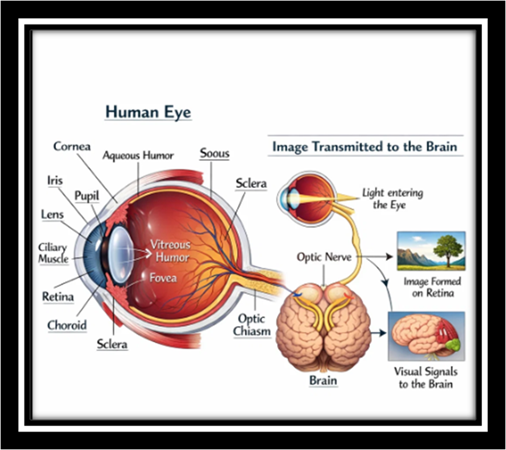
Answer:The human eye consists of:
- Cornea: Front transparent part that bends light.
- Iris: Colored part controlling pupil size.
- Pupil: Hole that lets light in.
- Lens: Focuses light onto retina.
- Retina: Light-sensitive layer with rods and cones.
- Optic nerve: Carries signals to the brain.
- Other parts: Ciliary muscles, aqueous humor, vitreous humor.
Image transmission: Light enters through the cornea and lens, which focus it onto the retina. The retina converts light into electrical signals via photoreceptor cells (rods and cones). These signals are sent through the optic nerve to the brain, which interprets them as visual images.
4. State few precautions taken for the care of eyes.
Answer: Precautions for eye care:
- Read in proper light; avoid too dim or too bright light.
- Do not look directly at the sun or bright lights.
- Maintain a distance while reading or using screens (about 25 cm for books, arm’s length for computers).
- Avoid rubbing eyes; wash them with clean water if irritated.
- Eat a balanced diet rich in vitamins.
- Wear protective goggles in hazardous environments.
- Have regular eye check-ups.
5. What is dispersion of light ? Describe a natural phenomenon based on dispersion of light.
Answer: Dispersion of light is the splitting of white light into its constituent colors (VIBGYOR) when it passes through a prism due to different wavelengths bending by different amounts.
Natural phenomenon: Rainbow is a natural phenomenon based on dispersion. When sunlight passes through raindrops in the atmosphere, each drop acts like a prism, splitting white light into colors. We see a circular arc of colors in the sky.
HIGHER ORDER THINKING SKILLS
1.Shalini has difficulty to see the blackboard from back bench of the classroom, though she can read her books comfortably. What type of vision defect she is likely to suffer from? How this defect can be corrected ?
Answer: Shalini likely suffers from myopia (nearsightedness). In myopia, a person can see nearby objects clearly but distant objects appear blurry. This happens because the eye lens is too curved or the eyeball is too long, causing images to form in front of the retina.
Correction: It can be corrected by using concave lenses (diverging lenses) in glasses or contact lenses. These lenses spread out light rays slightly before they enter the eye, helping the image focus correctly on the retina.
2.A man stands 5 m in front of a large plane mirror. How far must he walk before he is 5 m away from his image?
Answer: Initially, the man is 5 m in front of the mirror, so his image is 5 m behind the mirror. Distance between man and image = m.
We want the distance between man and image to be 5 m. Let the man walk meters towards or away from the mirror. Then his distance from mirror =
(if he walks away, x positive; if towards, x negative). Image distance behind mirror = same as man’s distance. So distance between man and image =
.
We set ⇒
⇒
⇒
m.
So he must walk 2.5 m towards the mirror. (Check: New distance from mirror = 5 – 2.5 = 2.5 m, image distance = 2.5 m behind, so separation = 5 m.)